Publications
-
Homeostatic Plasticity Enables Stable, Flexible, and Tunable Assemblies
Michelle Miller, Christoph Miehl, Brent Doiron
Bioarxiv. Paper in Review.
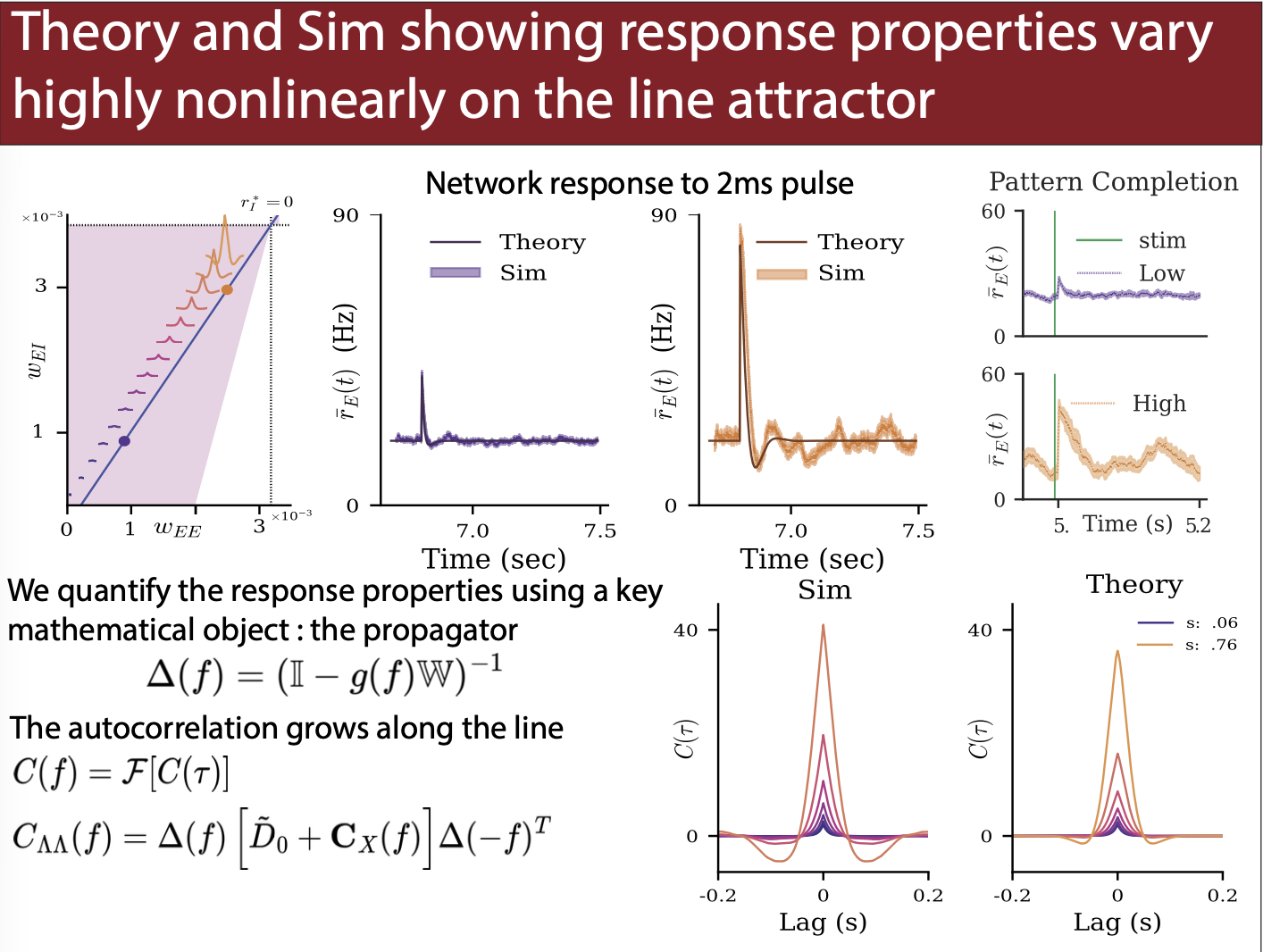
Strongly interconnected neuronal populations, called assemblies, dynamically form through synaptic plasticity mechanisms and are thought to be a substrate for memories in the brain. Many assembly formation models use Hebbian excitatory-to-excitatory plasticity, where coordinated activity strengthens recurrent structure. However, these models typically yield binary assembly outcomes: networks with either weak (no assembly) or maximally strong (assembly) connectivity. We consider networks with a combination of Hebbian excitatory-to-excitatory plasticity and inhibitory-to-excitatory synapses with plasticity that homeostatically stabilizes excitatory neuron firing at a target value. When we set excitatory-to-excitatory plasticity to be homeostatically compliant, in that potentiation and depression are balanced at the homeostatic target firing rate, we find a stable continuum of synaptic strengths, and assembly structure is no longer binary. We use a recurrent network of spiking neuron models and an associated mean-field theory to identify this continuum as a line attractor in synaptic weight space. While along the attractor, homeostasis ensures that neuronal firing rates are invariant, the dynamical response properties of the network are quite malleable, with strongly coupled networks having high gain and longer timescale responses. Using our mean-field theory we show how correlated stochastic spiking activity among the excitatory neurons can destroy the line attractor, yet this can be mitigated when correlated inputs are shared across the excitatory and inhibitory neurons. Altogether, we provide an alternative learning framework based on homeostasis, where a tunable and flexible assembly structure is possible.
-

Fading Ensembles supports memory-updating During Task Updating
(2024 -Poster at Society for Neuroscience Meeting 2023 ; Paper In Progress)
Authors: Michelle Miller **, Austin M. Baggetta**, Zhe Dong , Brian M. Sweis , Denisse Morales-Rodriguez , Zachary T. Pennington , Taylor Francisco , David J. Freedman , Mark G. Baxter, Tristan Shuman , Denise J. Cai
** Implies equal contribution
Memory updating is critical in dynamic environments because updating memories with new information promotes versatility. However, little is known about how memories are updated with new information. To study how neuronal ensembles might support memory updating, we used a hippocampus-dependent memory updating task to measure hippocampal ensemble dynamics when mice switched navigational goals. Using Miniscope calcium imaging, we identified neuronal ensembles (co-active neurons) in dorsal CA1 that were spatially tuned and stable across training sessions. When reward locations were moved during an updating test, a subset of these ensembles decreased their (co-activity?) activation strength, correlating with memory updating. These “fading” ensembles were a result of weakly-connected neurons becoming less co-active with their peers. Middle-aged mice were impaired in the updating task, and the prevalence of their remodeling ensembles correlated with their memory updating performance. Therefore, we have identified a mechanism where the hippocampus breaks down ensembles to support memory updating. To test this, we also developed a 1-layer hidden neural network with a reinforcement learning paradigm similar to the task-updating in the experiment. The model re-captures the behavior of the real animal by reaching peak hit rate, correct rejection rate, and discriminability index across sessions, which then drop and begin to improve again upon task switching. The network exhibits reward port over-representation. Further, upon reversal, we observe a negative correlation in the updated task performance and the number of units participating in stable ensembles.
-

Artificial Neuronal Ensembles with Learned Context Dependent Gating
Matthew J. Tilley, Michelle Miller & David J. Freedman
ICLR 2023
Biological neural networks can allocate different neurons for different memories, unlike traditional artificial neural networks which struggle with sequential learning and suffer from catastrophic forgetting. Introducing Learned Context Dependent Gating (LXDG), a method that mimics this biological capability. LXDG dynamically allocates and recalls artificial neuronal ensembles using gates, modulating hidden layer activities. It employs regularization terms to mimic biological properties, such as gate sparsity, recalling previous tasks, and ensuring orthogonal encoding for new tasks. LXDG alleviates catastrophic forgetting on continual learning benchmarks, surpassing Elastic Weight Consolidation (EWC) alone, notably on permuted MNIST. Additionally, LXDG shows that similar tasks recruit similar neurons, as seen in the rotated MNIST benchmark.
-

Divisive Feature Normalization Improves Image Recognition Performance in AlexNet
Michelle Miller, SueYeon Chung, Kenneth D. Miller
ICLR 2022
Local divisive normalization is a phenomenom observed in the brain in which adjacent normalize adjacent neural responses in visual cortical areas. It involves dividing the response of each neuron by a weighted sum of responses from neighboring neurons, which helps to enhance specific features in visual processing. In the context of the study, divisive normalization was applied between features in AlexNet, a convolutional neural network, to improve its performance in image recognition tasks. This adjustment consistently boosted the network's accuracy, especially when combined with other normalization techniques.